
Blog
How Much Do Hair Extensions Cost in Dubai?

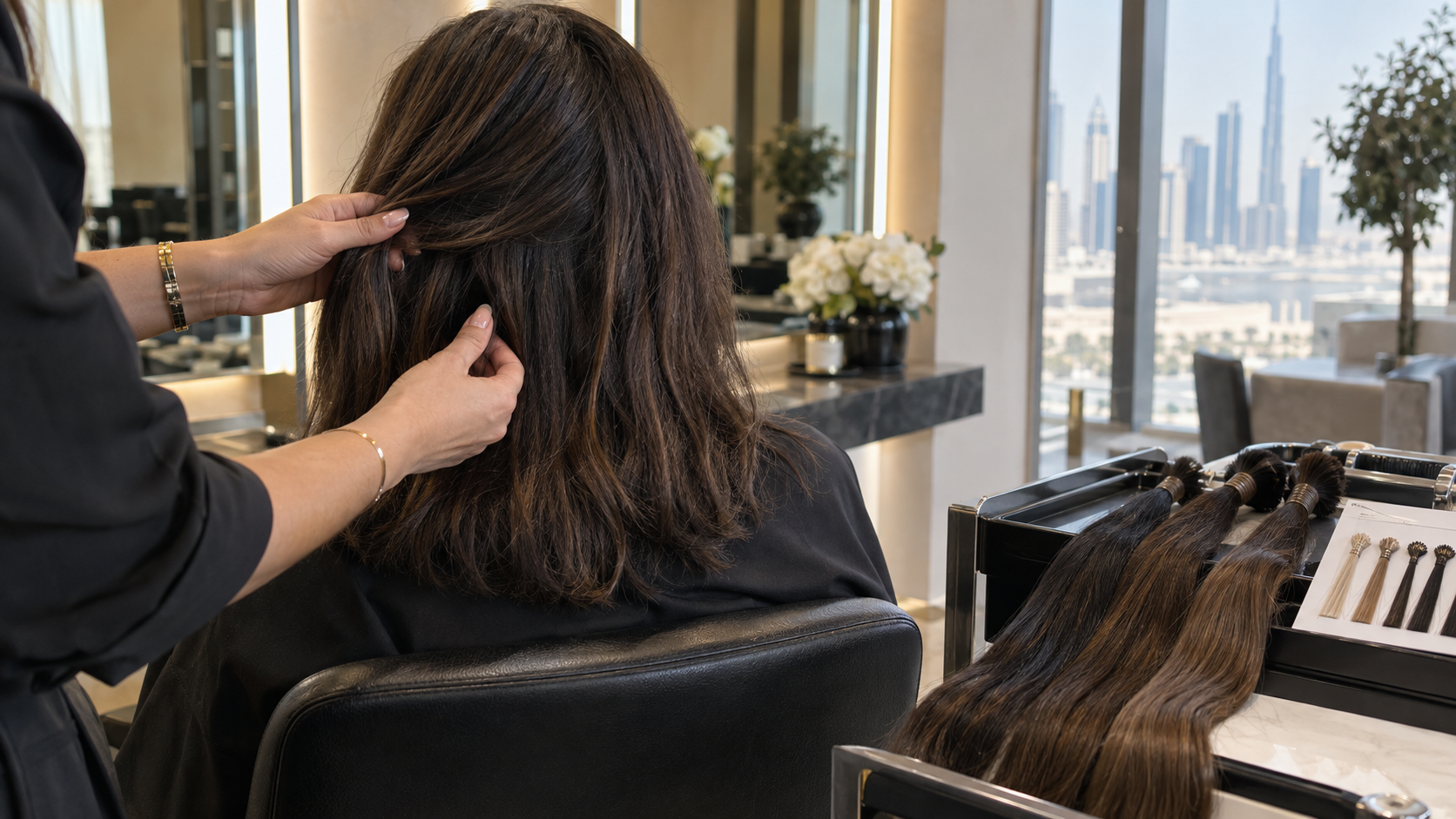
The cost of hair extensions in Dubai can vary considerably from one client to another.
A client adding a small amount of volume will not require the same quantity of hair, appointment time or technical work as someone transforming short hair into long, full hair. The final price also depends on the extension method, hair quality, desired length, colour and amount of blending required.
At Hani Hair in JLT, Dubai, extension services are customised following a professional consultation. The natural hair is assessed before the stylist recommends the method, quantity and length needed to create a balanced result.
Why Is There No Single Price for a Full Head?
“Full head” does not represent one fixed quantity.
One client may need approximately 100 strands to improve volume, while another may require around 200 strands or more to add both length and fullness. A client with short, thick or bluntly cut hair may need an even more detailed application to create a natural transition.
For this reason, a reliable quotation should be based on the client’s actual hair and desired result rather than a standard package that may provide too much or too little hair.
What Determines the Cost of Hair Extensions?
The main factors affecting the price include:
- The extension method
- The quality and origin of the extension hair
- The number of strands, tapes or wefts required
- The weight of the hair
- The chosen extension length
- The natural hair’s density and starting length
- The colour or combination of colours required
- Preparation and installation time
- Cutting, blending and finishing
- Future removal and maintenance
Understanding these factors makes it easier to compare quotations accurately.
The Hair-Extension Method
Different extension methods involve different products, preparation processes and application times.
Ice Hair Extensions
Ice extensions are installed strand by strand using a cold application method.
The attachment size can be customised during the application, allowing very detailed placement. A full transformation may involve hundreds of small strands, so the final cost depends heavily on the required quantity and the complexity of the work.
Ice extensions can be particularly useful for short-hair transformations and areas where small, discreet attachment points are needed.
Keratin Hair Extensions
Keratin extensions are also applied individually.
Each strand must be prepared with a keratin attachment and installed using controlled heat. The price may include preparation and installation, while the extension hair itself may be calculated separately.
Because keratin extensions are installed strand by strand, the number of pieces has a direct effect on the final cost.
Tape-In Extensions
Tape extensions are applied in wider sections rather than individual strands.
The price generally depends on the number of tape pieces or complete tape sandwiches required, the type of tape used and whether the extension hair is new or being professionally reapplied.
Regular and invisible tapes may also be priced differently depending on the product and design.
CombLine Extensions
CombLine is normally used for precision work in areas where traditional extension attachments may be difficult to conceal.
It can be selected for targeted volume, fine sections or carefully chosen areas around the head. The price depends on the size of the area, the amount of hair required and the time needed for the application.
Weft and Ring Extensions
Weft, micro-ring and nano-ring prices depend on the number of rows, rings or sections required.
Although these systems are not always calculated by individual strands, natural-hair density, head size and desired fullness still affect the total quantity and installation time.
How Many Extension Strands Do You Need?
The required quantity is one of the most important pricing factors.
As a general starting point:
- For volume only, approximately 100 pieces or more may be recommended.
- For additional length and volume, approximately 200 strands is a common full-head quantity.
- Major transformations involving very short, thick or blunt hair may require more strands.
- Longer transformations usually need more hair to keep the ends looking full and proportional.
These numbers are guidelines rather than guarantees. The size and weight of each extension strand can differ, so 100 very small strands do not necessarily provide the same amount of hair as 100 larger strands.
The natural hair must also be strong enough to support the recommended quantity.
Why Does Extension Length Affect the Price?
Longer extension hair generally costs more.
However, the increased cost is not only related to the length of each ponytail. When a client wants a dramatic increase in length, more extension pieces may also be necessary to prevent the finished hair from looking thin or separated through the ends.
For example, adding a small amount of length to medium-length hair may require less extension hair than transforming shoulder-length hair into very long hair.
The greater the difference between the natural length and desired length, the more detailed the blending process becomes.
Why Does Natural-Hair Density Matter?
The client’s starting density affects how much extension hair is necessary and how much can be supported safely.
Fine or Low-Density Hair
Fine hair may require smaller, lighter attachments and carefully controlled placement. The goal is not simply to install as many pieces as possible. Each attachment must be supported by an appropriate amount of healthy natural hair.
Some clients with fine hair may need fewer or lighter extensions, while others may need more small attachments to distribute the hair discreetly.
Thick or High-Density Hair
Thick natural hair usually requires more extension hair to create a balanced result.
If too little extension hair is installed, the client’s natural haircut may remain visible above the longer lengths, producing an obvious separation between the natural hair and the extensions.
Does Starting Length Affect the Cost?
Yes. Short hair is usually more challenging to extend naturally.
Short or blunt hair may require:
- More extension strands
- Smaller and more detailed attachment placement
- Additional colour blending
- More installation time
- A more detailed finishing haircut
- Careful distribution around short layers
Clients with longer, softly layered hair may require fewer pieces because the natural lengths can blend more easily into the extension hair.
Does Hair Colour Affect the Price?
Colour can affect the quotation when several shades are needed to reproduce the client’s natural dimension.
Many clients do not have one completely uniform hair colour. Their hair may include highlights, lowlights, balayage, natural regrowth or warmer and cooler sections.
Combining several extension shades can create a more natural result than using one flat colour throughout the head.
If suitable ready-made shades are unavailable, professional colouring, toning or preparation may involve an additional cost. Extension hair should not be bleached or chemically altered without first considering its condition and limitations.
Why Does Hair Quality Affect the Price?
Not all extension hair is equal.
Lower-priced extension hair may consist of mixed fibres, heavily processed hair or hair collected from multiple sources. It may initially appear smooth because of surface coatings but become dry or tangled after repeated washing.
At Hani Hair, each premium natural ponytail is cut from one donor rather than being assembled from mixed factory hair. Its price depends on factors such as:
- Length
- Weight in grams
- Natural colour
- Texture
- Quality and condition
- Availability of the selected shade
Single-donor hair can provide more consistent texture and movement throughout the ponytail, but its price varies because every ponytail is unique.
Is the Hair Included in the Installation Price?
Not necessarily.
Some salons advertise one combined price, while others calculate the extension hair and installation separately. Clients should always ask what the quotation includes.
At Hani Hair, the price of the selected natural hair may be separate from preparation and installation. This allows clients to understand what they are paying for and select a ponytail according to their desired length, colour, weight and budget.
A quotation may include or exclude:
- Extension hair
- Preparing the attachments
- Installation
- Colour customisation
- Cutting and blending
- Styling
- Removal
- Future maintenance
- Replacement adhesive or attachment materials
Always compare the complete service rather than only the advertised price per strand.
What Other Costs Should You Consider?
The first installation is not the only cost involved.
Depending on the method, future expenses may include:
- Professional removal
- Refill or reapplication appointments
- New tape tabs or attachment material
- Replacement of lost or damaged strands
- Cutting and blending
- Colour maintenance
- Extension-friendly brushes and products
- Replacement hair when the original hair reaches the end of its usable life
Some extension hair can be reused if its quality and condition remain suitable. However, repeated heat styling, dryness, discolouration, matting and poor aftercare may shorten its lifespan.
Why Is a Very Cheap Quotation Not Always Better?
A lower quotation may be based on less hair, lower-quality extension hair or fewer included services.
Before choosing based on price, ask:
- Is the hair natural?
- Is it single-donor or mixed hair?
- How many grams or strands are included?
- What is the length?
- Does the price include preparation and installation?
- Are cutting and blending included?
- What will removal and maintenance cost?
- Can the hair be reused?
- Who will perform the application?
- Is an in-person assessment included?
A quotation should be clear enough for you to understand exactly what result and service you are receiving.
Can You Get an Accurate Price From a Photograph?
A photograph can help the salon understand your preferred style, but it may not provide enough information for an exact quotation.
Pictures do not always show:
- The true density of the natural hair
- Individual strand strength
- Areas of breakage
- The condition of the scalp
- The exact starting length
- The weight of hair required
- Whether attachments can be concealed
- The complexity of the client’s colour
An in-person consultation allows the stylist to assess these factors and show the client suitable hair options.
How to Receive an Accurate Hair-Extension Quotation
During your consultation, be prepared to discuss:
- Whether you want length, volume or both
- Your preferred finished length
- How you normally wear your hair
- Your previous extension experience
- Your colour history
- Your maintenance preferences
- Your expected budget
- Any breakage, sensitivity or hair-loss concerns
The stylist can then recommend an appropriate method and calculate the required hair, quantity and technical work.
Book a Hair-Extension Consultation at Hani Hair Dubai
The cost of hair extensions in Dubai depends on much more than the advertised price per strand.
At Hani Hair in JLT, Dubai, we assess your natural hair and help you select the extension method, length, colour, quantity and single-donor ponytail needed for your desired transformation.
Following the consultation, you will receive a personalised quotation based on the hair and service required—not an unsuitable one-price-fits-all package.
Contact Hani Hair to arrange your consultation and receive an accurate quotation for your hair-extension transformation.